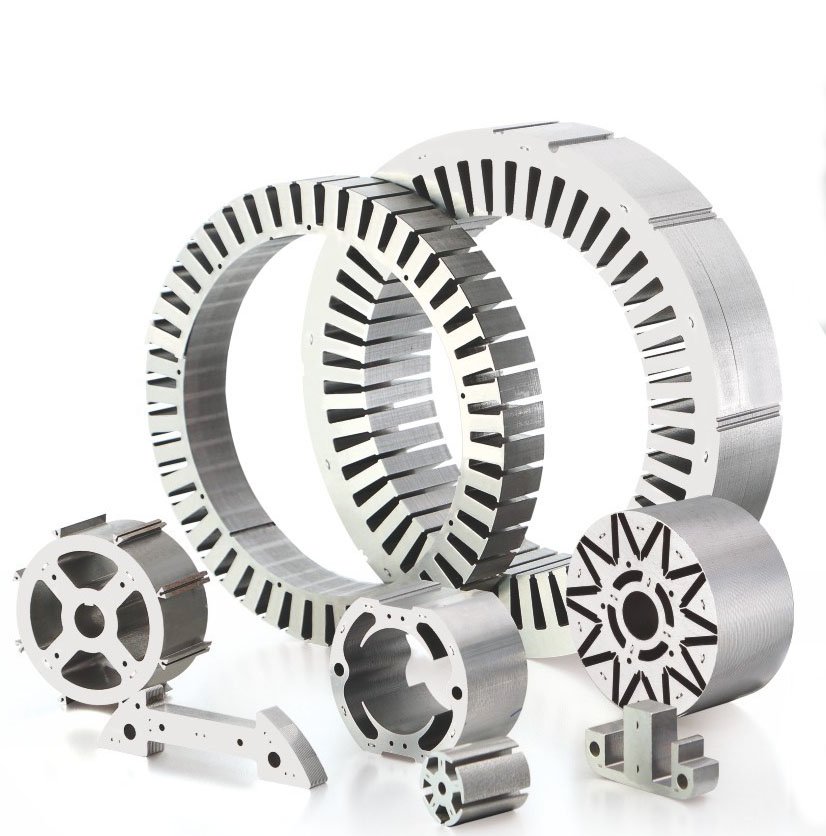
In motor core tooling projects, delays are rarely caused by machining speed or workshop capacity.
In most cases, months are lost much earlier — during the transition from RFQ to actual tool design.
Drawings may look complete, dimensions may be fully defined, yet critical production information is still missing. When that happens, tooling design proceeds on assumptions, and assumptions inevitably surface later as redesigns, revisions, or engineering disputes.
This article outlines the design information that genuinely shortens tooling lead time, not by accelerating manufacturing, but by eliminating avoidable iterations at the engineering stage.
Lamination Stack Definition Goes Beyond Single-Sheet Geometry
Many projects start with a precise lamination drawing but lack a clear definition of the final stack.
Tooling design depends not only on the geometry of a single lamination, but also on how laminations behave as a stack in real production. Key points that must be clarified include:
- Stacking method: interlocking, welding, bonding, or hybrid
- Target stack height: per piece or final assembly
- Whether elastic compression of the stack is acceptable
- Required consistency of stack height across production
Without this information, interlock depth, forming force, and die clearance are often defined conservatively. If stacking requirements are revised later, the tool structure may need fundamental changes rather than simple tuning.
Material Specification Must Be More Than “Electrical Steel”
Material definition is one of the most underestimated sources of tooling delay.
Specifying thickness alone is not sufficient. For tooling design, the following parameters directly influence cutting strategy, tool life, and stability:
- Steel grade and steel mill
- Coating type and coating behavior during stamping
- Hardness range and batch-to-batch consistency
- Expected sourcing stability during the tool’s lifetime
Two materials with identical thickness can behave very differently during high-speed stamping. When material assumptions change after design freeze, the impact is rarely local — it often affects punch material selection, clearance strategy, and maintenance intervals.
Burr Height Requirements Must Include Measurement Logic
A burr height target without a defined measurement method is incomplete engineering input.
To avoid late-stage disputes, the following must be clearly stated:
- Measurement location (tooth tip, slot edge, outer diameter, etc.)
- Measurement method (optical, tactile, average vs maximum)
- Whether the requirement applies to initial samples or over tool lifetime
In many projects, burr requirements are interpreted differently by laboratories and production environments. Clarifying this upfront avoids last-minute rework requests during FAT or sample approval.
Production Volume and Tool Lifetime Assumptions Drive Structural Decisions
Annual volume and total lifetime strokes are not interchangeable inputs.
Tooling structure, insert material, redundancy, and re-machining allowance depend on whether the priority is:
- Short-term production with limited lifetime expectation, or
- Long-term stable production over hundreds of millions or billions of strokes
When lifetime assumptions are unclear, tooling is often designed either overly conservative or insufficiently robust — both leading to revisions once real production plans emerge.
Feeding Mode and Automation Strategy Must Be Declared Early
Feeding mode is not an accessory decision; it is a structural one.
Whether the tool is intended for manual feeding, continuous feeding, or future automation upgrades directly affects:
- Die opening
- Strip guidance
- Structural symmetry
- Allowable tolerance accumulation
Designing a tool for manual feeding first and “upgrading later” is often unrealistic without structural compromises. Declaring the long-term feeding strategy before design begins prevents irreversible constraints.
Potential Change Scenarios Should Be Defined, Not Avoided
Design changes are common in motor projects, but unmanaged changes are costly.
It is far more efficient to define expected change scenarios upfront, such as:
- Rotor variants with shared outer geometry
- Interchangeable punch sets versus full die replacement
- Whether future product families are anticipated
This does not mean overengineering. It means allowing tooling designers to reserve flexibility where it matters, instead of reacting under schedule pressure later.
Conclusion
Tooling lead time is not determined by machining hours alone.
It is largely defined by the quality of information available before tooling design starts.
Clear design inputs do not serve the toolmaker — they protect the project itself.
By aligning design intent, production reality, and future expectations at the outset, months of avoidable iteration can be eliminated before the first steel block is cut.